

- Chandigarh UT
- Creative Corner
- Dadra Nagar Haveli UT
- Daman and Diu U.T.
- Department of Administrative Reforms and Public Grievances
- Department of Biotechnology
- Department of Commerce
- Department of Consumer Affairs
- Department of Industrial Policy and Promotion (DIPP)
- Department of Posts
- Department of Science and Technology
- Department of Telecom
- Digital India
- Economic Affairs
- Ek Bharat Shreshtha Bharat
- Energy Conservation
- Expenditure Management Commission
- Food Security
- Gandhi@150
- Girl Child Education
- Government Advertisements
- Green India
- Incredible India!
- India Textiles
- Indian Railways
- Indian Space Research Organisation - ISRO
- Job Creation
- LiFE-21 Day Challenge
- Mann Ki Baat
- Manual Scavenging-Free India
- Ministry for Development of North Eastern Region
- Ministry of Agriculture and Farmers Welfare
- Ministry of Chemicals and Fertilizers
- Ministry of Civil Aviation
- Ministry of Coal
- Ministry of Corporate Affairs
- Ministry of Culture
- Ministry of Defence
- Ministry of Earth Sciences
- Ministry of Education
- Ministry of Electronics and Information Technology
- Ministry of Environment, Forest and Climate Change
- Ministry of External Affairs
- Ministry of Finance
- Ministry of Health and Family Welfare
- Ministry of Home Affairs
- Ministry of Housing and Urban Affairs
- Ministry of Information and Broadcasting
- Ministry of Jal Shakti
- Ministry of Law and Justice
- Ministry of Micro, Small and Medium Enterprises (MSME)
- Ministry of Petroleum and Natural Gas
- Ministry of Power
- Ministry of Social Justice and Empowerment
- Ministry of Statistics and Programme Implementation
- Ministry of Steel
- Ministry of Women and Child Development
- MyGov Move - Volunteer
- New Education Policy
- New India Championship
- NITI Aayog
- NRIs for India’s Growth
- Open Forum
- PM Live Events
- Revenue and GST
- Rural Development
- Saansad Adarsh Gram Yojana
- Sakriya Panchayat
- Skill Development
- Smart Cities
- Sporty India
- Swachh Bharat (Clean India)
- Tribal Development
- Watershed Management
- Youth for Nation-Building
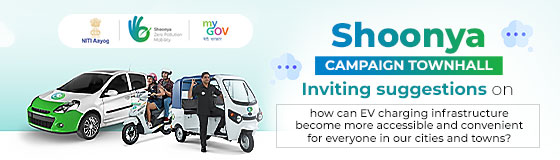
Shoonya Campaign Townhall - Inviting Suggestions on how can EV charging infrastructure become more accessible and convenient for everyone in our cities and towns

Start Date :
Jan 16, 2024
Last Date :
Feb 16, 2024
23:45 PM IST (GMT +5.30 Hrs)
The NITI Aayog-led Shoonya campaign, in partnership with MyGov India, is thrilled to announce the electric vehicles Townhall, an open discussion platform for citizens to share ...
All Comments
Featured
New Comments
Showing 435 Submission(s)
Suyash Verma
2 years 4 months ago
In conclusion, fostering accessible and convenient electric vehicle (EV) charging infrastructure in our cities and towns necessitates a comprehensive strategy that addresses various facets of the charging ecosystem. Expanding public charging networks, standardizing connectors, implementing smart solutions, and ensuring accessibility for all are pivotal steps. Collaboration with private businesses, incorporation into urban planning, and the development of fast-charging corridors contribute significantly to the overall convenience. Multi-unit charging stations, flexible payment options, and robust government support further enhance the user experience and incentivize widespread adoption.
Like
(12)
Dislike
(3)
Reply
Report Spam

Suyash Verma
2 years 4 months ago
Fast-charging corridors along major highways are essential to alleviate concerns about range limitations, promoting long-distance travel for EV users. Additionally, the provision of flexible payment options, including pay-per-use, subscription models, and contactless payments, will contribute to a seamless and user-friendly charging experience. Government support in the form of financial incentives, tax breaks, and grants is instrumental in encouraging both public and private entities to invest in charging infrastructure. Moreover, regulatory measures mandating the inclusion of EV charging stations in new construction projects will further accelerate the expansion of the charging network. Ultimately, an inclusive and convenient EV charging infrastructure requires a holistic and collaborative approach involving government bodies, private stakeholders, and local communities. By prioritizing these initiatives, cities and towns can lay the foundation for a sustainable and accessible system
Like
(13)
Dislike
(2)
Reply
Report Spam
Suyash Verma
2 years 4 months ago
Educational campaigns and community engagement initiatives can raise awareness and garner support, while government backing in the form of incentives, grants, and regulations will play a pivotal role in driving the widespread adoption of EVs and the development of accessible charging infrastructure. By combining these efforts, cities and towns can create a seamless and inclusive EV charging network, promoting sustainable transportation for all. Furthermore, the deployment of multi-unit charging stations should be prioritized to accommodate multiple vehicles simultaneously, reducing wait times and ensuring efficiency. Collaboration with private businesses and property owners should be actively pursued, offering them incentives to install charging stations, thus fostering the growth of a comprehensive private charging network. Integration of EV infrastructure into urban planning should extend to new developments, parking structures, and transportation hubs, ensuring that charging station
Like
(13)
Dislike
(2)
Reply
Report Spam
Suyash Verma
2 years 4 months ago
To enhance the accessibility and convenience of electric vehicle (EV) charging infrastructure in cities and towns, a multifaceted approach is essential. Firstly, there needs to be a concerted effort to expand public charging networks, strategically placing charging stations in high-traffic areas, parking lots, and residential neighbourhoods. Standardizing charging connectors will simplify the user experience and encourage broader EV adoption. Implementing smart charging solutions that enable users to locate, reserve, and pay for charging through mobile apps or online platforms is crucial. Ensuring that charging stations are accessible to people with disabilities and incentivizing businesses to install charging points on their premises can further broaden the reach of the infrastructure. Integration of EV charging considerations into urban planning, development of fast-charging corridors along highways, and providing flexible payment options contribute to overall convenience.
Like
(12)
Dislike
(2)
Reply
Report Spam
GARAIYA AKSHAY
2 years 4 months ago
The availability of fossil fuels is limited, and their use is destroying our planet. Toxic emissions from petrol and diesel vehicles lead to long-term, adverse effects on public health. The emissions impact of electric vehicles is much lower than petrol or diesel vehicles. From an efficiency perspective, electric vehicles can covert around 60% of the electrical energy from the grid to power the wheels, but petrol or diesel cars can only convert 17%-21% of the energy stored in the fuel to the wheels. That is a waste of around 80%. Fully electric vehicles have zero tailpipe emissions, but even when electricity production is taken into account, petrol or diesel vehicles emit almost 3 times more carbon dioxide than the average EV. To reduce the impact of charging electric vehicles, India is ambitious to achieve about 40 percent cumulative electric power installed capacity from non-fossil fuel-based energy resources by the year 2030.
Like
(11)
Dislike
(2)
Reply
Report Spam
GOBINDA BAG
2 years 4 months ago
thank
Like
(9)
Dislike
(3)
Reply
Report Spam
SANTOSH SINGH MIROLA
2 years 4 months ago
colaboration between governments and private businesses can attract investment, making charging infrastructure more widespread. ovide financial incentives or tax breaks for businesses and individuals to install charging stations, encouraging broader adoptionn nvolve local communities in the planning and installation process, ensuring that charging stations meet specific needs and gain local support. Implement smart grid technologies to optimize charging schedules and reduce costs, making EV charging more efficient and affordable.Develop common standards for charging infrastructure, promoting interoperability and reducing costs for manufacturers and consumers.
Explore creative financing options, such as crowd-funding or subsidies,
Like
(12)
Dislike
(2)
Reply
Report Spam
Gajulamadhuri
2 years 4 months ago
1. **Community Collaboration:** Engage with local communities to identify suitable locations for charging stations, ensuring accessibility and convenience for residents.
2. **Multi-Functional Spaces:** Integrate charging infrastructure into existing public spaces like parking lots or shopping centers to maximize convenience and utilization.
3. **Incentives for Businesses:** Provide incentives for businesses to install charging stations, promoting a widespread and accessible network.
4. **Standardization of Charging Stations:** Advocate for standardized charging connectors and protocols to simplify usage and compatibility.
5. **Public-Private Partnerships:** Collaborate with private companies to invest in charging infrastructure, combining resources for a more extensive and efficient network.
6. **Smart Infrastructure:** Implement smart technologies to optimize charging station locations based on demand patterns and enable real-time monitoring and maintenance.
7. **Education and O
Like
(13)
Dislike
(2)
Reply
Report Spam
Rajesh Banerjee
2 years 4 months ago
:
1. **Public-Private Partnerships (PPPs):**
Encourage collaboration between government bodies and private entities to invest in and deploy EV charging stations.
2. **Incentives for Charging Infrastructure Installation:**
Provide financial incentives or subsidies for businesses and property owners to install EV charging stations. This can be done through tax credits, grants, or other financial support mechanisms.
3. **Mandatory Inclusion in New Developments:**
Integrate regulations or incentives that require new commercial and residential developments to include EV charging infrastructure in their parking facilities.
4. **Standardization of Charging infrastructure
5. Strategic placement of Charging stations.
6. Integration with Renewable Energy Sources: Combine EV charging infrastructure with renewable energy sources like solar and wind power.
7. Education and Awareness Campaigns:
Conduct public awareness campaigns to educate citizens about the benefits of EVs.
Like
(12)
Dislike
(2)
Reply
Report Spam
MOHAMMAD SHAD
2 years 4 months ago
Less consumption of Bio Fuel is directly proportional to reduction every development problems.
Like
(9)
Dislike
(3)
Reply
Report Spam
- View More